
Montmorency County Warrant Searches
Montmorency County warrant questions start with the courts, because a warrant is a court order and the clerk who keeps the file is the office that can confirm it. The 88th District Court handles traffic, civil infractions, misdemeanors, felony arraignments and preliminary examinations. Its magistrate issues arrest and search warrants. Felony files move to the 26th Circuit Court after bind over, and family matters sit with that division. Service and surrender questions go to the sheriff. Call with the full legal name. Add the birth year. A case, warrant or ticket number skips name matching entirely, which matters in Montmorency County, where families have shared surnames for generations.
- Search MiCOURT for the 88-2 District Court entry by name or case number.
- Search the 26th Circuit entry for a felony after bind over or a family case.
- Search the ticket or case number in the state ePAY tool for traffic and civil infractions.
- Call the clerk who keeps the case to confirm current warrant status and bond.
- File a written county FOIA request when the record you need is not online.
The court case-search hub is the page that opens both Montmorency court routes.
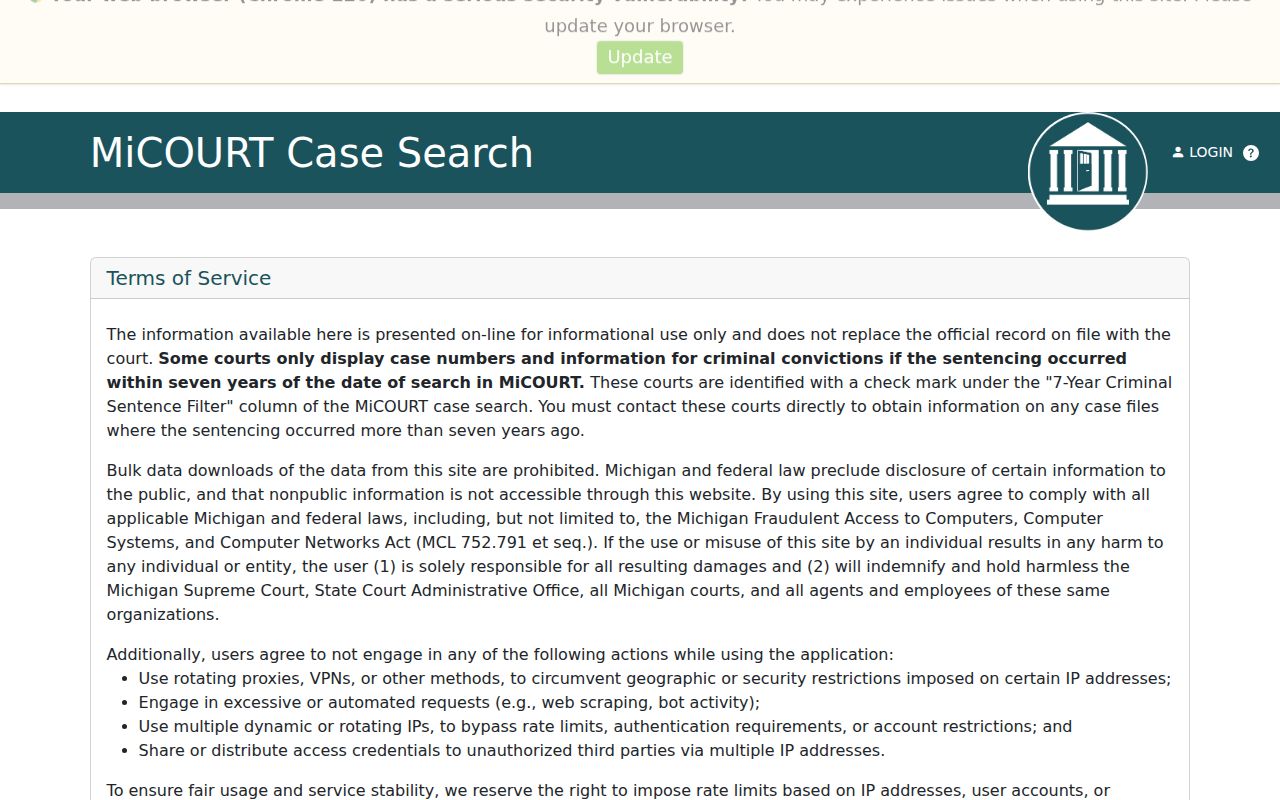
Both routes start from that one county page.
Two Montmorency Warrant Search Routes
MiCOURT splits Montmorency County between two court entries, and the wrong pick returns an empty page that looks like good news. One entry, marked 88-2 District Court, handles traffic, civil infractions, misdemeanors and the early stages of a felony. The circuit entry takes felony files after bind over. It adds family, juvenile and friend-of-the-court matters. Not sure where the case sits? Then run both entries, since a case number from one court returns nothing in the other. Neither entry shows restricted case types.
What a Warrant Search Asks For
A Montmorency County warrant check in the public case search asks for less than you might expect. One last name is enough to search. Other fields just narrow a long list, and the case tab takes a year, a number and a case type instead. Michigan wants a birth year only.
| Field Label | Type | Required | Notes |
|---|---|---|---|
| Court Notice | Selected court | Yes for a local search | Names the Montmorency court you opened |
| Last Name or Business | Text | Yes for a name search | A partial entry can return nothing |
| First Name | Text | No | Narrows a common surname |
| Middle Name | Text | No | Separates people with similar names |
| Birth Year | Text | No | Year only in the public interface |
| Case Number | Year, number, type | No | Separate tab for a case search |
Filters sit beside the results. They help on a crowded Montmorency County surname, but they never widen what the court publishes.
Ticket Warrant Searches in Montmorency
A ticket is not a criminal case. Montmorency County tickets live in the state's ticket and case tool, which opens with a county and court dropdown and then offers four search modes. Use it for your own court ticket. Do not treat it as a way to build a driving profile.
| Search Mode | What You Enter | Notes |
|---|---|---|
| Last Name and Ticket | Last name plus ticket or case number | Fastest route when the citation is in hand |
| Last Name and Birth Date | Last name plus month, day and year | Useful when the ticket number is lost |
| Driver License Number | License number and state | Identifies the court ticket only |
| License Plate Number | Plate and state | Matches a vehicle to its court case |
The state ticket and case search lists a Montmorency County ticket's court, balance and status, but no insurance or points. It is not a driving record.
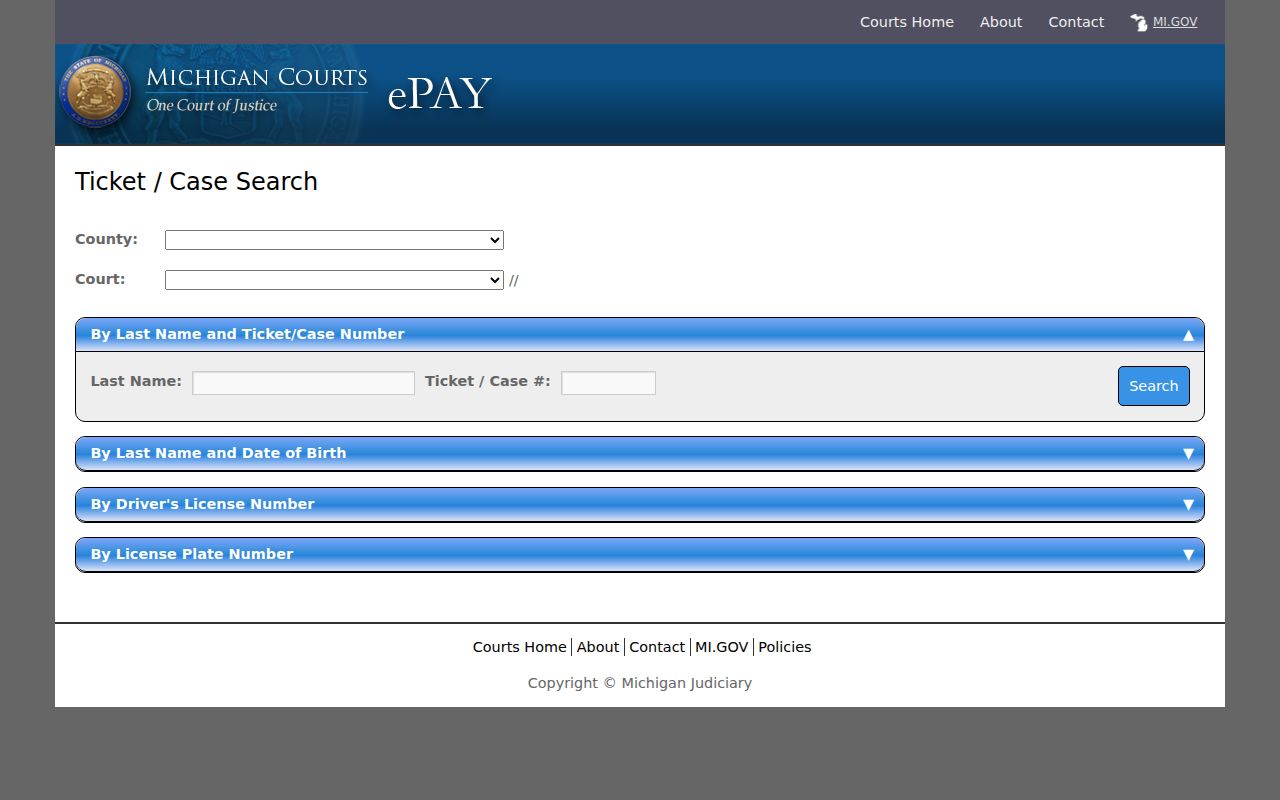
Match the court on the citation to the court you select in the form.
Montmorency County Warrant Search Results
A result is a case trail, not a warrant flag. Montmorency County's case-search page says a record may show the register of action, hearing dates, party names, counsel, case status and financial history. That is a lot of detail. A case can stay public while the warrant paperwork or the identifying details sit behind a restriction.
| Case number | The file identifier, with the format set by the court, for example 2024-CR-01234 |
|---|---|
| Case type | Criminal, traffic, civil infraction or another category |
| Party name | The name on the docket, which may be shortened |
| Register events | Hearings, failures to appear, bond entries, recalls and returns in date order |
| Financial history | Fines, costs, payments and any default on the case |
| Status | Open, closed, pending or otherwise as the court reports it |
Read a Montmorency County docket in order. A failure-to-appear entry, then a warrant entry, then a recall tells a different story than an open warrant with nothing after it.
Reading Montmorency Warrant Records
The register of action is the court's own running list of every filing in a Montmorency County case, written so a few words carry most of the meaning. Court shorthand fills it. It is not legal advice.
- Register of action
- The dated list of filings and events in a case, from the complaint forward.
- Default judgment
- What the traffic page says follows a citation that goes unanswered or a hearing that is missed.
- Recall
- The court withdraws the warrant, usually after an appearance, a payment or a motion.
- Quashed
- The court sets the warrant aside while the underlying case continues.
- Return
- The officer's report back to the court after service or an attempted service.
Montmorency County Warrants: Who Holds What
Each office here holds a different piece. Mixing them up costs a day. The 88th District Court clerk keeps the district file, including traffic defaults and misdemeanor cases, and the criminal and traffic deputy clerk is the desk that answers warrant questions there. The 26th Circuit Court and County Clerk keep circuit files after bind over, plus family matters. The sheriff's office is the law-enforcement contact for service, booking and surrender logistics rather than the office that issues or recalls a warrant. The county handles its own records through FOIA. State tools cover tickets and public case information. No Montmorency office publishes an active-warrant list. In Montmorency County, a warrant question really means calling the desk that holds the file.
Montmorency FOIA for Warrant Records
When nothing shows online, the next step in a Montmorency County warrant search is a written request to the public body that holds the record. The county's FOIA guidebook describes an optional form. Responses come in five business days. One ten-day extension is possible. Copying runs ten cents a sheet, labor is billed in fifteen-minute increments, and a deposit of up to half applies when an estimate passes fifty dollars. Ask for something that exists. A warrant return, a docket entry or a named Montmorency County case file can be answered. A broad request for every open warrant can be narrowed or denied, because the county does not have to build a new list. Court files follow the court rules, not county FOIA.
The guidebook also lists the appeal path to the Board of Commissioners.
Which Warrants Stay Restricted
Public case search is a partial view by design. Some Montmorency County records never appear, and the reason is a rule or a court order rather than a technical glitch.
Key Rules:
Sealed and suppressed cases are withheld from the public interface, and the courts site warns that nonpublic cases may not publish.
Juvenile, child-protective and several other civil case types are excluded from Michigan's public search.
A warrant connected to an open investigation can be held back even when the case itself is public.
A missing result is not proof that no warrant exists, because a new warrant may not be entered yet.
When a record falls into one of those categories, the issuing court division is the only office with answers. That is true across Montmorency County.
Why Montmorency Warrant Results Go Blank
A blank result from a Montmorency County warrant search answers one narrow question. It means the tool found no public case for the name you typed. That is all it means. A warrant can still exist, because new warrants may not appear in public entries yet, and recalls can lag behind. The case may sit with a different court or division, the record may be restricted, and federal warrants live in a separate system entirely.
Note: Confirm status with the clerk who keeps the case, because the court of record controls and the online view is only informational.